
By Carla Halioua
Israel’s recognition of Somaliland has triggered strong regional backlash. Somalia called the move illegal and a violation of its sovereignty, while Egypt, Turkey, Djibouti, the Arab League, and the African Union warned it could destabilize the Horn of Africa. Critics frame the decision as symbolic provocation or ideological posturing. However, Israel’s recognition of Somaliland appears to be driven by concrete strategic considerations tied to maritime security, regional power competition, and emerging alliance structures – not symbolism.
Geography as Strategy
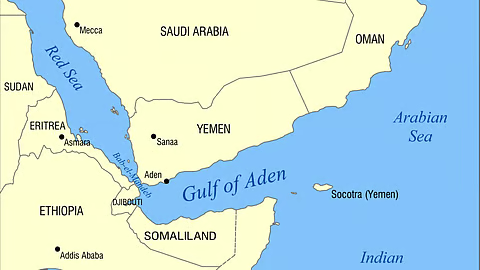
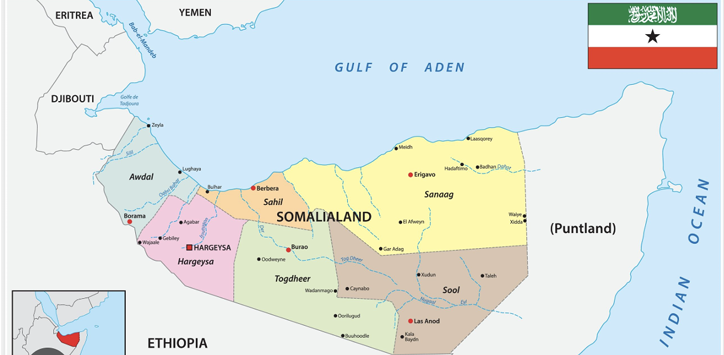
Somaliland’s strategic value begins with its geography. Located at the junction of the Red Sea and the Indian Ocean, it overlooks the Bab El-Mandeb Strait – one of the world’s most important maritime chokepoints1. The port of Berbera sits along shipping lanes that carry a significant share of global trade, including energy supplies bound for Europe and Asia. Since 2023, repeated attacks by the Houthis on vessels in and around the Red Sea have directly affected Israeli-linked shipping, forcing rerouting around the Cape of Good Hope and increasing costs and delays. From Israel’s perspective, securing access to this corridor is a core economic and security interest.
Security Cooperation Without Military Presence
As discussed by Somalia analyst Omar Mahmood at the International Crisis Group think tank, recognition enables Israel to deepen security coordination with Somaliland without requiring a formal military footprint2. Israeli officials have emphasized that the move does not involve establishing military bases or stationing troops. Instead, it opens avenues for intelligence sharing, maritime surveillance, and cooperation aimed at protecting commercial shipping from threats such as the Houthis and al-Shahaab.
___________________________________
1 Reuters, “Why is Somaliland strategically important?”, Reuters, January 6, 2026, https://www.reuters.com/world/middle-east/why-is-somaliland-strategically-important-2026-01-06/
2Cornwell Alexander, Paravicini Giulia, “Israeli foreign minister visits Somaliland, angering Somalia”, Reuters, January 6, 2026, https://www.reuters.com/world/middle-east/israeli-foreign-minister-visiting-somaliland-sources-say-2026-0 1-06/
___________________________________
Analysts note that such cooperation can exist below the threshold of overt militarization, reducing escalation risks while still enhancing regional security capabilities.
Continuity with the Abraham Accords Logic
The recognition also fits squarely within strategic logic of the Abraham Accords3. Like Israel’s normalization with Gulf States, the Somaliland decision prioritizes shared interests – security, trade, and stability – over adherence to long-standing diplomatic taboos. The United Arab Emirates, which already manages and invests in Berbera port, stands to benefit from expanded regional connectivity linking Gulf logistics, African markets, and Israeli ports. Recognition thus reinforces an emerging regional order based on pragmatism rather than ideology.
Political Reality Over Diplomatic Fiction
Opponents argue that recognizing Somaliland undermines Somalia’s territorial integrity and risks encouraging separatist movements elsewhere. Yet this position ignores Somaliland’s distinct political reality. Since 1991, Somaliland has exercised effective autonomy, maintained relative peace, held regular elections, and built functioning institutions – conditions that sharply contrast with those in Somalia. International law places significant weight on effective governance and popular consent, both of which Somaliland demonstrably possesses. Recognition, in this sense, reflects facts on the ground rather than symbolic defiance.
Rejecting the Gaza Relocation Narrative
Much of the outrage surrounding the recognition has focused on allegations that Israel intended to relocate Palestinians from Gaza to Somaliland or establish military bases there. Both Israel and Somaliland have explicitly denied these claims, calling them politically motivated attempts to discredit Somaliland’s diplomatic outreach. Even the Arab League’s accusations rest on speculation rather than evidence: its UN ambassador, Maged Abdelfattah Abdelaziz, warned against “any measures arising from its illegitimate recognition aimed at facilitating forced displacement of the Palestinian
___________________________________
3Reuters, “Israel becomes first country to formally recognize Somaliland as independent state”, Reuters, December 27, 2025, https://www.reuters.com/world/middle-east/israel-recognises-somaliland-somalias-breakway-region-indep endent-state-2025-12-26/.
___________________________________
people, or exploiting northern Somali ports to establish military bases”4, despite the absence of substantiated plans supporting such assertions. The persistence of this narrative reflects broader regional tensions rather than the substance of the agreement itself.
A signal in a Competitive Region
Finally, the recognition must be understood in the context of intensifying great-power competition in the Horn of Africa. China, Turkey, Iran, and Gulf states have all expanded their economic and security footprints in the region. China’s strong opposition to Somaliland recognition reflects its interest in preserving the status quo and protecting its strategic investments in Djibouti and along Red Sea routes. By recognizing Somaliland, Israel signals its intention to play an active role in shaping the region’s security architecture rather than remaining strategically constrained.
Strategy, Not Sentiment
What Israel’s recognition of Somaliland ultimately reveals is a broader transformation in regional diplomacy. As instability spreads across the Red Sea, states are increasingly prioritizing functionality over formality and cooperation over convention. Recognition is therefore about identifying actors that can contribute to security, stability, and access in a fragmented regional order. In this sense, Somaliland constitutes a signal. The rules of engagement are changing, and diplomacy is adapting accordingly.
___________________________________
4 Nichols Michelle, “Israel defends Somaliland move at the UN amid concerns over Gaza motives”, December 30, 2025, https://www.reuters.com/world/middle-east/israel-defends-somaliland-move-un-amid-concerns-over-gazamotives-2025-12-29/.
2Cornwell Alexander, Paravicini Giulia, “Israeli foreign minister visits Somaliland, angering Somalia”, Reuters, January 6, 2026, https://www.reuters.com/world/middle-east/israeli-foreign-minister-visiting-somaliland-sources-say-2026-0 1-06/
___________________________________


 English
  עִבְרִית