
By Ted Rosner
Historical Background:
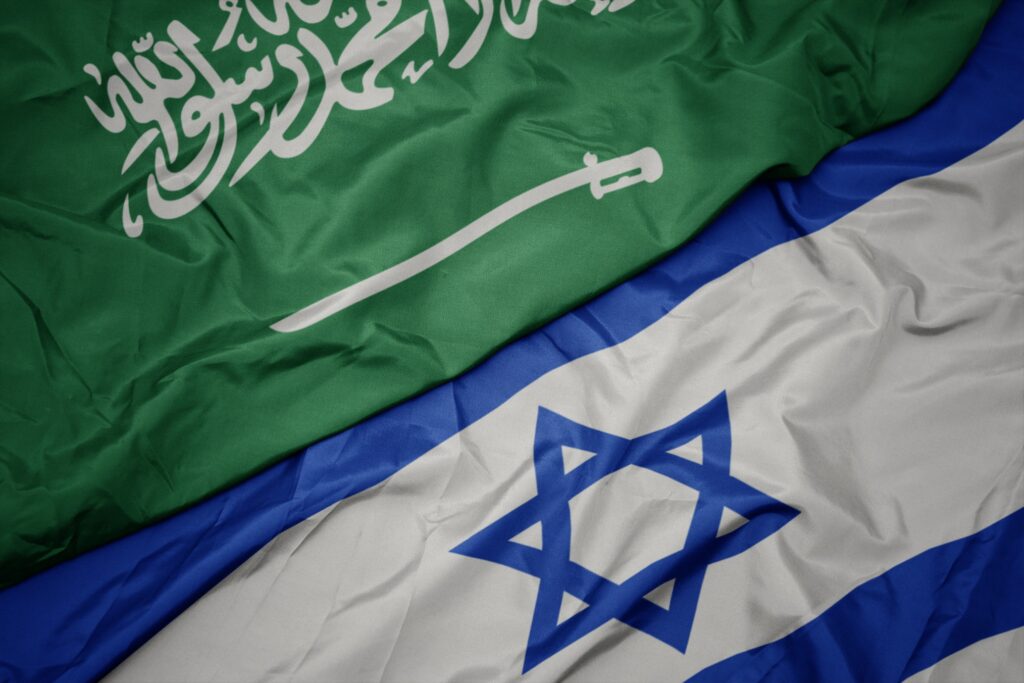
Since Israel’s establishment in 1948, Israel and Saudi Arabia have never had diplomatic relations. This dates back to 1947 when Saudi Arabia voted against the United Nations Partition Plan for Palestine, rejecting the establishment of a Jewish state. Saudi Arabia supported the Arab League’s stance of opposition toward Israel throughout the Arab-Israeli conflict. For decades, this policy reflected both solidarity with the Palestinian cause and Saudi Arabia’s role as guardian of Islam’s holiest sites. (University of Michigan).
Fast-forwarding to 2020, the Abraham Accords normalized relations between Israel and several Arab states, specifically, the United Arab Emirates, Bahrain, Morocco, and Sudan. Later, bilateral negotiations between Israel and Saudi Arabia made progress in 2023, with the United States as the mediator. These talks represented a historic opportunity to create peace in the Middle East. The Saudi government, however, had stated that they will accept the terms of the deal if the issue of an independent Palestinian state is resolved.
Interests and Considerations
Both Israel and Saudi Arabia have national interests that would make a diplomatic agreement mutually beneficial for Israelis and Saudis.
For Saudi Arabia, a diplomatic agreement would create an opportunity for U.S. support and to enhance its global standing. As such, the Saudis have presented three major conditions for the establishment of formal ties:
- Security Guarantees: A U.S. commitment to defend Saudi Arabia from external threats, such as Iran.
- Advanced Weaponry: Access to sophisticated weapons, including F-35 fighter jets and missile defense systems.
- Civil Nuclear Development: U.S. approval for a nuclear energy program with uranium enrichment capabilities, which is supposed to diversify Saudi energy sources and match Iran’s nuclear progress. (Institute for Policy and Strategy {IPS} 2023).
On the other hand, Israel would consider normalization with Saudi Arabia a major milestone in its quest to make peace with the Arab world. Israel’s integration with the Arab world would potentially cause not only other Arab states to follow the Saudi’s lead, but the opportunity to create a stronger force against the Iranian threat. “Is Saudi-Israel Normalization Still on Track” (Jewish News Syndicate {JNS} 2024).
In the future, chances for normalization remain uncertain, especially with the unresolved Palestinian issue, opposition from Iran and its proxies, and U.S. hesitation over Saudi nuclear enrichment. But if achieved, Saudi Arabia’s inclusion in the Abraham Accords would create one of the most important diplomatic achievements in the history of the Middle East. It would build bridges between Judaism and Islam by bringing enemies together in shared harmony and cooperation.
References:
University of Michigan:
Har-Zvi, Shay
“Is Saudi-Israel Normalization Still on Track” Jewish News Syndicate

